Why We Built Lumi — and the two moments I can't stop thinking about
This isn't a polished origin story. It's just what actually happened.
I left my wallet at hotel during a trip to Malaysia.
Not a big deal, I thought. I never really use it anyway. I live on my phone — everything's on there. I'd be fine.
Later, I took a cab from my hotel to a restaurant.
I was not fine.
📍 Kuala Lumpur, Malaysia
The cab pulled up outside the restaurant. The driver turned around and waited. I reached into my pocket for my wallet and — nothing. Just my phone.
No worries, I thought. I'll pay on my phone somehow. But I didn't have any local payment app set up. My credit card wasn't linked to anything he could accept. He started showing me his QR code. Again. And again. Each time a little more frustrated, a little more resigned.
I just stood there. Phone in hand. Money in my account. And absolutely no way to pay the man standing right in front of me.
The shame of that moment was something specific. It wasn't the embarrassment of forgetting something — that happens to everyone. It was the feeling of being completely helpless in a situation that should not exist. I had a smartphone. I had money. The technology existed. And yet, somehow, none of it could close a ten-foot gap between me and a cab driver who just wanted to get paid for his work.
I had everything I needed — except the one thing that actually mattered in that moment.
We sorted it eventually. Someone nearby stepped in to help. But I sat in my room that night and couldn't let it go. I started thinking about the real cost of how we move money across borders.
Credit cards? Over 5% in total fees once you add up the foreign transaction charge, the currency conversion markup, and whatever your bank quietly takes. And that's when the merchant even has a card machine — which, in huge parts of the world, they simply don't.
Cash? I always end up carrying three currencies "just in case," worrying about losing it, and coming home with a pile of useless leftover notes I'll never use again.
Neither option was actually working. They were just the options we'd all quietly accepted.
📍 Northern Thailand, A Few Days Later
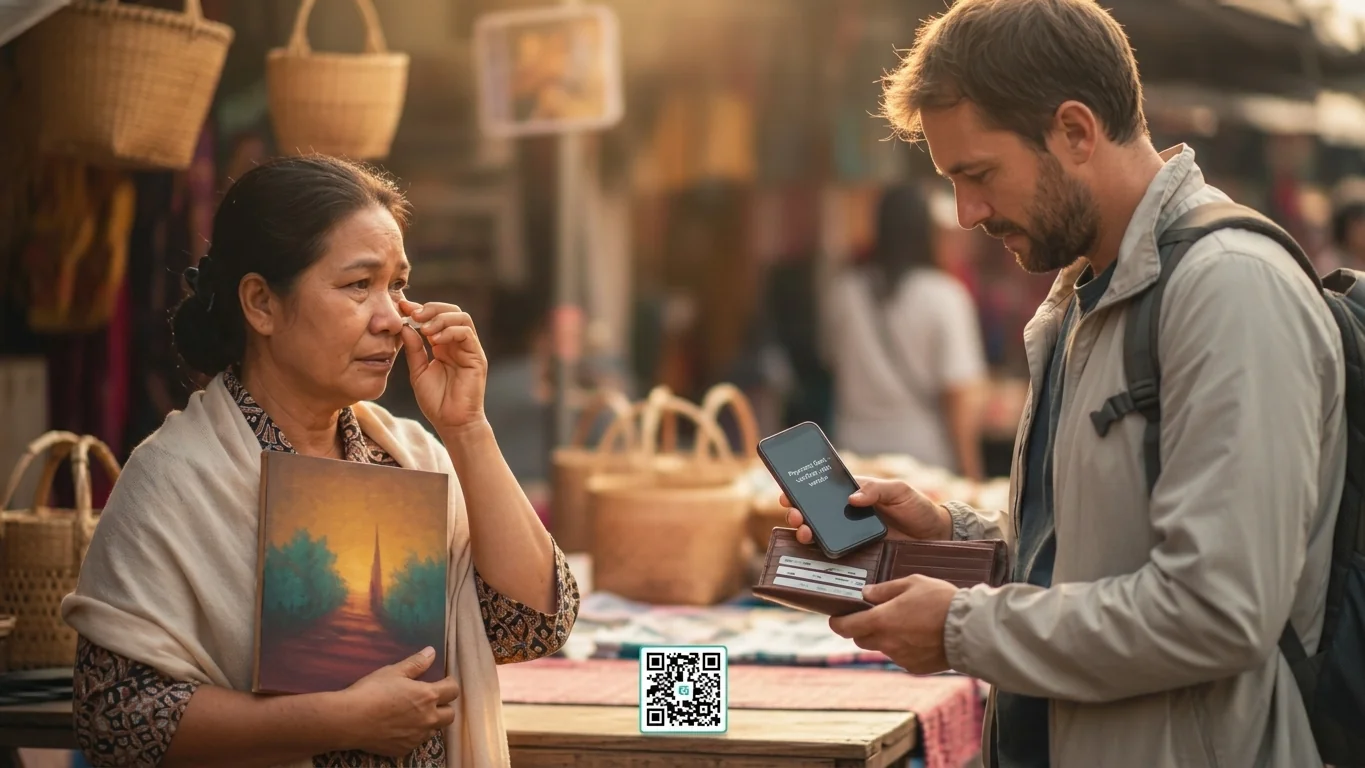
I was walking through a small town — not a tourist spot, just a real place — when I saw an older woman sitting on the roadside with the most beautiful handmade artwork laid out around her. Intricate, colourful pieces that clearly took real skill and real time.
I stopped. I wanted to buy something.
She looked up and smiled, and in careful, broken English she pointed to a QR code she'd printed out and laminated. She'd clearly done this before — prepared for this exact situation, hoping for this exact customer.
I felt sick.
I only had euros on me. Not thai baht, not a working QR payment setup, nothing she could use. I tried to explain. She kept pointing at the code, switching between Thai and fragments of English, not understanding why this wasn't working. And then, slowly, she seemed to understand.
She picked up one of her paintings and held it out to me.
A gift. For free.
There were tears in her eyes.
I couldn't take it. I shook my head, said thank you, and walked away. Not because I didn't want it — I wanted it more than anything in that market. But because she needed to sell it, not give it away to some tourist who couldn't figure out how to pay her.
That walk away was the moment everything became clear to me.
She had prepared everything she could. A QR code. A smile. Hope. And the global payments system still failed her.
That's when we decided to build something.
The technology to fix this already exists. QR payments, digital wallets, interoperable systems — none of this is new. What's missing is something that brings it together in a way that actually works for the cab driver in KL and the artist on a roadside in Thailand, not just for people who are already plugged into the right apps and banks.
That's what Lumi is trying to be.
Not another fintech product for people who already have everything. Something genuinely more inclusive — that works whether you're the one travelling or the one waiting for a customer, whether you have a card machine or a laminated QR code, whether you're in a major city or a small town that the formal banking system forgot about.
I think about that woman a lot. I don't know her name. I never got the painting. But every decision we make building Lumi, I ask myself the same question: would this have helped her?
If the answer is no, we're not done yet.
If you've ever been stuck on the wrong side of a broken payment — as a customer or a seller — I'd genuinely love to hear about it.
— Lumi Founder