Vietnam Skipped the Card Era. Your Mastercard Didn’t Get the Memo.
VietQR explained — and why foreigners can’t use the apps that run daily life in Vietnam.
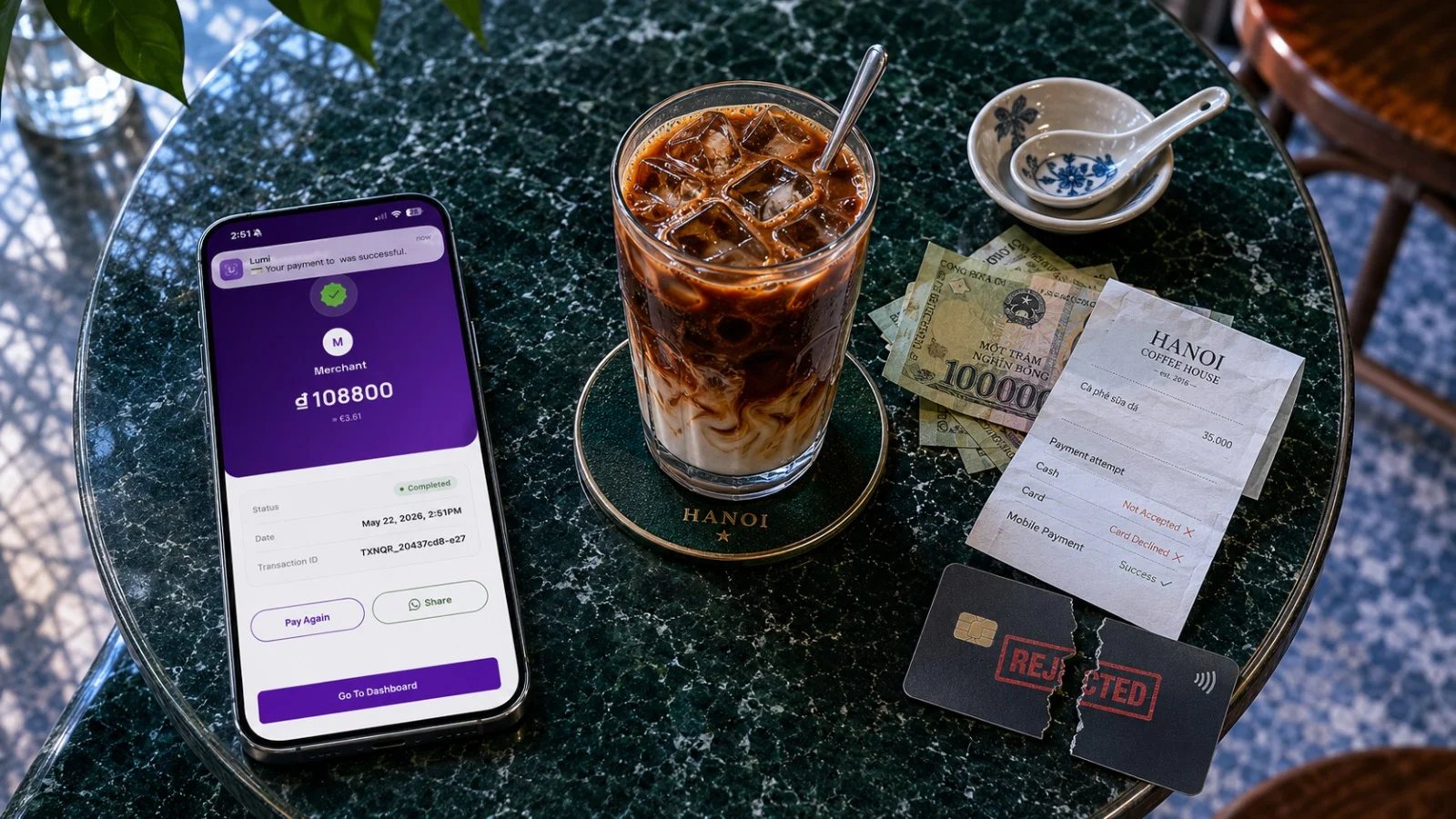
A Hanoi café, three failed taps
Almost no one in Vietnam carries a wallet anymore. They carry a phone. They scan a QR code, hear a small beep from the merchant’s speaker, and it’s done. A bánh mì paid for in three seconds.
Meanwhile, your Premium Mastercard sits useless in your back pocket at a Hanoi café. The waiter has tried the card machine twice. The guy at the next table just paid for his iced coffee with a glance at his phone.
This is the story of how Vietnam built a payment system that quietly works better than ours. And why your bank still hasn’t figured out how to talk to it.
The leap, in numbers
Fifteen years ago, Vietnam ran on cash. About 99% of retail in 2010 was paper money.
Today is different. The State Bank of Vietnam (SBV) says non-cash payments grew more than 50% in 2024 by transaction count. QR payments alone more than doubled. MoMo, the most popular wallet, has passed 31 million users. That’s roughly half the adult population. Walk through a wet market in Hanoi and you’ll see grandmothers selling vegetables with a QR code propped against a cucumber.
For comparison: China took about ten years to make the switch to mobile money. India did it in five with UPI. Vietnam did it in around six, without a Tencent and without a government push as forceful as India’s. The country built a shared QR rail (VietQR) and let four local apps fight over the rest. The fight is still going. That’s part of why it works.
Meet the four systems
People often think Vietnamese payments are one app. They’re not. There are four players, each doing a different job.
VietQR is the rails. It’s not an app you download. It’s a shared QR format that any Vietnamese bank or wallet can read. NAPAS launched it in 2021. It’s why a Vietcombank customer can pay a Techcombank merchant by pointing a phone at a piece of paper. In daily life: that A4 sheet taped to the wall of the cơm tấm shop, with the owner’s account number on it.
MoMo is the consumer wallet. It started as a phone top-up app and grew into Vietnam’s version of WeChat Pay. Bills, food delivery, ride payments, gold, lottery tickets — all in one app. In daily life: paying back a friend who covered last weekend’s Grab. You don’t open your bank app for that. You open MoMo.
ZaloPay sits on top of Zalo, the messaging app that beat WhatsApp in Vietnam years ago. You use it when paying is part of a conversation. A school parents’ group collecting class-trip money. A Zalo seller posting a dress for sale. In daily life: a Tết red envelope dropped into a group chat.
VNPay is the bank-and-merchant network. Less flashy. More everywhere. It powers most retail point-of-sale across supermarkets, utility bills, airlines, and government services. If MoMo is the wallet in your hand, VNPay is the plumbing behind the “Pay by QR” button in your bank app. In daily life: paying your electricity bill by scanning the code on the invoice.
So: VietQR is the language, the three apps are dialects, and they all work with each other. No one in Vietnam thinks about which logo is on the sticker.
Why your card fails
It’s not really a tech story. It’s a money story.
A Vietnamese café that takes Visa or Mastercard pays around 3% per swipe once you add up issuer, scheme, acquirer, and FX fees. A café that takes VietQR pays close to nothing. Usually under 0.3%, often zero. NAPAS keeps the cost low, and most banks throw in free QR for merchants to win their business.
On a 50,000 đồng iced coffee, the difference is small. On a 5-million đồng dinner bill, it’s a day of staff pay. Across a month of dinners, it’s rent.
This is why even cafés in District 1 that call themselves “international friendly” quietly prefer you scan. The card machine is there for the foreigner who insists. It’s not the rail they would choose. Starbucks and McDonald’s still take cards because their parent companies have global card deals. Walk three doors down and the math flips.
Vietnam didn’t push Visa out. Visa just never won the merchant fight. The country jumped straight from cash to QR. It skipped the years where shops bought card terminals and ate the 3% fee as a cost of doing business. There was no installed base of card machines to defend. So the cheaper rail won by default.
Why you can’t sign up
You can stand in a Vinmart, watch the local in front of you pay in under two seconds with MoMo, and want very much to do the same thing. You won’t be able to. Here’s why.
To open a MoMo, ZaloPay, or any local wallet, you need three things. All of them have to be issued in Vietnam.
A Vietnamese national ID — the chip card called CCCD gắn chip. For foreigners, a long-term residence card works. A tourist visa stamp does not. The app checks your ID against the government database and rejects passports that aren’t linked.
A Vietnamese mobile number tied to the same ID. Since the 2023 SIM clean-up, every active number is supposed to be registered to a verified national ID. Tourist SIMs don’t pass wallet checks.
A Vietnamese bank account. That itself means walking into a branch with your passport, valid visa, proof of address, and usually a work permit or residence card. Neobanks like Cake, Timo, and TNEX have lighter sign-up flows. But they still ask for the same paperwork.
The wall isn’t an accident. It’s how Vietnam follows anti-money-laundering rules and keeps wallet fraud low. Compared to the Philippines or Indonesia, fraud cases per million users in Vietnamese wallets are noticeably lower, and the strict KYC is a big reason why.
The cost is real, though. If you’re a tourist, a digital nomad on a 90-day visa, or a business traveler in for a week, the local payment system is closed to you. Not unfriendly — just closed.
What works today
A few honest workarounds, in order of usefulness.
Wise. Wise can send VND straight into a Vietnamese bank account. But you still need an account on the other end. Useful for one-off payments — a landlord, a contractor. Not for daily life. Trade-off: you need a Vietnamese person to receive it.
A friend’s MoMo. The most common move for long-stay foreigners. Hand a friend cash. They MoMo it where you need it to go. Trade-off: awkward above $100 and impossible to scale.
E-commerce loopholes. Shopee, Lazada, and Grab take international Visa and Mastercard directly. You can order food, ride, and shop without ever touching VietQR. Trade-off: doesn’t help at the bánh mì cart.
Hotels. Mid-range hotels and up will often charge MoMo top-ups, Grab credits, or bills to your room. They pay in VND. You pay them with your card at checkout. Trade-off: small spread.
And bring cash. ATMs are everywhere and the exchange rate is fine. Notes of 500,000 đồng are useful for hotels and taxis; smaller notes are useful for almost everything else. Avoid changing money at the airport — the rate at any bank in town is better, and the gold shops on Hà Trung in Hanoi are better still.
What’s changing in 2026
The wall is starting to crack. In early 2026, the SBV confirmed the next step in the ASEAN cross-border QR link. Vietnamese travellers can already scan Thai PromptPay codes with their bank apps. Thai visitors scanning Vietnamese QRs went live in pilot cities late last year. A Singapore–Vietnam link with PayNow is being built. Cambodia is reportedly next.
What this doesn’t fix is the foreigner problem from the other direction — a French traveller scanning a VietQR with a French bank app. That’s the harder one. It needs interbank settlement with non-ASEAN systems, and European and American banks don’t have a commercial reason to bother yet. SBV officials have said they’re “open to” wider foreign access. They haven’t put a date on it.
The honest forecast: by the end of 2026, anyone with a Thai, Singaporean, Malaysian, Indonesian, or Cambodian bank app will be able to pay at a Vietnamese street stall. Everyone else still queues at the ATM. If you’re reading this from London, New York, or Berlin, plan accordingly.
The Lumi take
This is the kind of fragmentation we’re working to smooth out. A single layer over local rails, so travellers and remote teams can pay in Vietnam without the KYC headache.
If you move money in and out of Vietnam often, we have a quieter path than handing your friend a stack of cash. Before your next trip:
Tell your card company you’re travelling so they don’t block you.
Bring at least 3 million đồng in cash for the first two days.
Install Grab and Shopee before you land. Both take foreign cards.
Staying more than 30 days? Ask your hotel about MoMo top-ups in their name. Most will do it.